


Low Visibility Drones: A Complete Guide to Drone Operation
Operating drones in harsh conditions such as low visibility (e.g., fog, night, smoke, rain, or dense haze) presents both unique challenges and opportunities.
While standard VLOS (Very Low Visibility) rules limit many flights, modern sensors, lighting equipment, and operating procedures make safe and efficient operation possible.
This guide comprehensively covers the regulations, risks, techniques, best practices for low visibility drones, and practical applications for flying drones in limited visibility conditions.
What is Low Visibility?
Low visibility occurs when atmospheric conditions reduce the distance at which objects are clearly visible. When drones are operating in the air, reduced visibility weakens situational awareness, significantly impacting operational efficiency.
Low visibility environments include:
- Fog or mist
- Night or dusk
- Smoke (from fire or industrial pollution)
- Heavy rain, heavy snow, or dust storms
- Dense haze or low cloud cover
Low Visibility Operations (LVO) refers to specialized procedures and techniques that enable aircraft to operate safely in conditions of reduced visibility (such as fog, heavy rain, or snow).

How does visibility affect drone operations?
The visual camera lens of a drone is crucial for the drone to perceive its surroundings. When visibility decreases, drones are prone to losing their line of sight, significantly reducing their ability to detect, perceive, and avoid obstacles. Drone pilots may also face loss of vision, leading to improper operation and increasing the risk of drone accidents.
What is the minimum visibility for unmanned aircraft operations?
The FAA requires drone pilots to maintain a minimum visibility of three miles (approximately 4.8 kilometers) when flying in Category C airspace.
In addition, most drones must adhere to regulations requiring a flight altitude not exceeding 400 feet, the installation of strobe lights for nighttime operation, and maintaining visual line-of-sight (VLOS) flight. BVLOS flight requires an exemption.
Exemptions may be applied for for public safety, infrastructure, or scientific research missions involving low visibility or BVLOS flight, but detailed safety instructions are required.
Key Technologies for Low Visibility Flight
Modern drones enhance their performance with specialized sensors and systems, expanding their applications and overcoming many limitations. Let's look at these key technologies, payloads, and sensors.
Collision avoidance lights and navigation lights: High-intensity strobe lights (visible at distances exceeding 3 miles) are essential for nighttime flight and are strongly recommended for use in fog.
- Thermal imaging (FLIR + Thermal): Detects the thermal signature of people, vehicles, or animals—highly effective at night or in light smoke/fog.
- Millimeter-wave radar: Penetrates fog, rain, smoke, and darkness for reliable obstacle avoidance (typically with a detection range of 20-30 meters or more).
- Starlight or low-light camera: High-sensitivity full-color night vision.
- AI-enhanced vision system: Real-time image processing improves clarity in harsh environments.
- RTK/GPS + inertial navigation: Maintains positioning accuracy even without visual reference.
- Obstacle avoidance: Multi-sensor fusion (radar + vision + ultrasonic) enables safer autonomous flight.
Enterprise-grade flight platforms, such as the Autel EVO Max series, equipped with millimeter-wave radar, offer multiple payload options, 720° omnidirectional obstacle avoidance, and IP45 weatherproof design, making them ideal for public safety and inspection work.
Drone operations in low visibility conditions
Low-visibility drone photography
When you want to capture sunsets, hazy blue skies, or nighttime city photography, the ability of a high-quality camera drone to capture images in low-light conditions will definitely impress you.

In low-light environments, the light captured by a drone's camera sensor is significantly reduced, affecting image clarity, brightness, and luminance. The Autel EVO II PRO V3 photography drone features a 1-inch sensor, an adjustable aperture of f/2.8-f/11, and Moonlight 2.0 algorithm supporting a maximum ISO of 44000. It can generate 12-bit DNG photos and 6K video, significantly outperforming other drones in its class in nighttime photography.
The Autel EVO II PRO V3 is a favorite among drone photographers for its nighttime capabilities. However, the Autel EVO II PRO V3 6K drone does not come with an official nighttime collision avoidance light accessory and must be purchased separately.
Public Safety and Policing in Low Visibility Conditions
Police work often occurs more frequently and is more challenging at night. Nighttime searches, suspect tracking, fire monitoring, and traffic surveillance in low visibility conditions are typically very slow to accomplish manually.
Drones, equipped with thermal imaging drones, Loudspeakers, Spotlight, starlight night vision cameras, and zoom cameras, can accelerate nighttime aerial reconnaissance, warning, and information dissemination, improving personnel safety and efficiency in public safety and policing operations in low visibility conditions.
For nighttime public safety drones, I recommend the EVO II Enterprise series and EVO Max series. Their powerful performance significantly enhances nighttime safety and facilitates proactive incident response.

Inspection Work in Low Visibility
Rain, snow, and fog severely impact visibility, significantly reducing the distance at which visual objects can be seen. Power lines, power towers, utility poles, wind turbines, bridges, and pipelines are also highly vulnerable, frequently resulting in power outages for repairs and reports of structural cracks.
Drones enable safer navigation and mission execution in dark or hazardous environments, helping frontline workers gather information faster, perceive their surroundings, and expedite inspection and maintenance. Spotlight accessories also provide aerial illumination, enhancing aerial visibility for nighttime inspections.
The Autel EVO Max series features a top-mounted fisheye lens, visual + millimeter-wave radar obstacle avoidance, and GNSS-free navigation, greatly aiding in inspection work. The Max 4T supports 10x lossless zoom, while the Max 4N supports full-color night vision.

Drone Search and Rescue in Low Visibility
Many search and rescue teams and fire departments deploy thermal drones for search and rescue operations. Drones use thermal imaging technology to locate missing persons in dark or foggy conditions.
Drones significantly improve detection and retrieval capabilities in low-light and nighttime conditions. The Autel EVO II 640T V3's thermal camera can detect human heat sources at a distance of 500 meters, and the EVO Max 4N drone's starlight camera operates in lighting conditions as low as 0.0001 Lux with ISO up to 450,000, making it an ideal search and rescue drone for nighttime operations.

Choosing the Right Low-Light Drone
Choosing the right low-light drone solution depends on your operating environment, aircraft platform, and mission requirements.
The Autel Enterprise series always puts user needs first, working closely with various industries to accelerate operational efficiency, optimize project cycles, reduce labor costs, and support business operations.
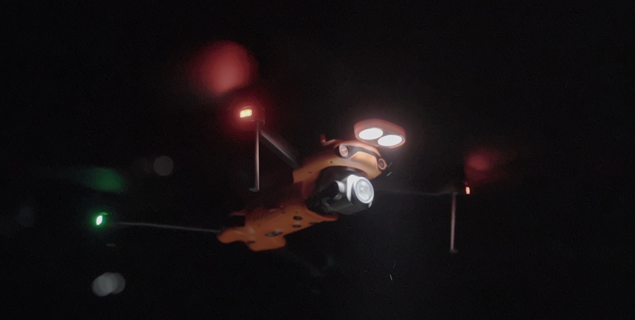
Risks and Challenges of Drone Operations in Low Light
Loss of visual contact: Pilots may be unable to determine the drone's position, attitude, and altitude.
Obstacle detection failure: Cameras and even some LiDAR systems may malfunction in fog, smoke, or darkness.
Spatial orientation obstacles: Reduced horizon and ground reference points increase pilot workload.
Battery and performance issues: Low temperatures or humidity shorten flight time and reduce sensor reliability.
Visual avoidance limitations: Other aircraft are more difficult to detect.
Summary
Low visibility operations require higher-quality enterprise drones, more streamlined processes, and more prudent decision-making. Always prioritize the safety of people, property, and airspace.
With adequate preparation, equipment, and the right mindset, drones can accurately perform critical missions in extremely poor visibility conditions, turning challenges into operational advantages.