


Facade Inspection Drones: Why Are More and More Property Management Companies Using Drones?
With the increasing number of high-rise buildings in cities, facade inspection has become an important and high-risk task for property management companies. Traditional structural facade surveys are gradually being replaced by drone inspections.
Drone vs. Rope Access: Why UAVs Are Replacing Traditional Building Inspections. Let's take a look.
How is curtain wall inspection conducted manually in the traditional way?
High-rise facade inspections can cost tens of thousands of dollars to build scaffolding, use ropes, or employ aerial work platforms. Workers often use suspended baskets or spider-like maneuvers, and during these operations, they must be careful to avoid high-risk accidents such as falls, electric shocks, and falling objects.
Manual facade inspection is extremely inefficient and has limited accuracy. The results of manual visual inspections are easily affected by various objective factors.
How can drones be used for facade inspection?
Exterior facade inspection drones combine high-resolution visible light cameras with thermal imaging optics, enabling property managers to complete thorough external audits within hours, providing the team with repeatable and data-rich results.
1. Significantly Enhanced Security
Drone inspections take off automatically, eliminating the need for ground personnel to set up any climbing devices, significantly reducing the accident rate. Inspectors only need to plan the drone's flight path in advance on the remote controller, and the drone will automatically conduct inspections without any ground operation.
2. Revolutionary Increased Efficiency
A single drone's 30-minute operation far exceeds the inspection range of a single person working a full day. High-quality thermal imaging drones support automatic inspection route planning and can repeatedly execute fixed routes, enabling comprehensive inspections of 3-5 high-rise buildings per day.
3. Significantly Improved Inspection Accuracy

When selecting exterior facade inspection drones, high-resolution camera drones and dual-light camera drones are the best choices. High-resolution camera drones can magnify and capture details in high definition, reducing blind spots. A dual-light system drone combining visible light and thermal imaging can quickly identify hidden problems such as voids, water seepage, delamination, and insulation layer failure that are difficult to detect.
Drone operations can magnify defect features, significantly improving detection accuracy.
4. Significantly Reduced Costs
In the long run, the overall cost of drone inspections is far lower than manual labor. Once invested, it can be reused for many years, reducing the cost per inspection by 60%-80%.
5. Data-Driven and Intelligent Management
After a drone's planned flight mission, it generates a large number of high-definition photos and videos. This data provides reliable support for subsequent thermal imaging reports, 3D models, and the creation of digital building archives.
Key Functions Property Managers Need When Selecting Facade Drones
Before evaluating a specific model, it is crucial to understand which technical specifications are most important when flying close to large concrete, glass, and steel structures:
Dual-sensor imaging (visible light + thermal imaging): You need high-resolution visible light to detect cracks, rust, and sealant failures. You need infrared thermal imaging to detect moisture infiltration, subsurface delamination (hollow tiles), and insulation layer gaps.
All-around obstacle avoidance: Flying within meters of a skyscraper facade is extremely risky. Superior collision resistance or millimeter-wave radar obstacle avoidance is essential.

Strong anti-jamming capabilities: High-rise building environments are filled with dense Wi-Fi signals, cellular base stations, and magnetic field interference from steel reinforcement. Drones with weak transmission capabilities will experience signal loss.
RTK accuracy (real-time dynamic positioning): RTK provides centimeter-level positioning accuracy. This allows drones to overcome the effects of gusts of wind near walls and ensures your data has perfect georeferencing for 3D modeling.
But which drone platform is best suited for your portfolio? This ultimate buyer's guide for 2026 will detail the top facade inspection drones on the market.
1. Autel EVO Max 4T V2 — Best Autonomous Drone

For business managers overseeing high-rise buildings or densely populated urban properties, the Autel EVO Max 4T V2 is a superior and secure device.
Sensor Suite: It features a multi-sensor payload, including a 50MP wide-angle camera, a 160× hybrid zoom camera, an 8K 48MP zoom camera, and a 640x512 high-resolution thermal imaging sensor.
Obstacle Avoidance: The EVO Max series employs an industry-leading binocular vision system combined with millimeter-wave radar technology. It achieves true 360-degree obstacle avoidance, even in low-light conditions or when flying over reflective glass windows that traditional optical sensors cannot detect.
Anti-interference capability: Equipped with robust anti-jaw and anti-interference flight control modules, it maintains excellent stability even when operating near dense steel structures.
Payload Compatibility: The EVO Max series also supports the addition of RTK payloads, further enhancing the accuracy of drone mapping.
2. Autel EVO II Dual 640T V3 — Best-in-Class Thermal Imaging Drone Deployment

If your property management team needs a highly flexible tool for quick, ad-hoc structural assessments without the need for a large enterprise-level deployment, this compact, high-performance device is the perfect choice.
Sensor Kit: Equipped with an 8K visible light camera and a 640x512 thermal imaging sensor.
Rapid Deployment: The Autel 640T V3 thermal drone is highly portable and takes off simply by unfolding its wings. Its geofencing-free capability eliminates the need for your team to waste valuable time unlocking airspace restrictions in time-sensitive structural emergencies, such as immediately assessing damage after a storm.
Thermal Imaging Capabilities: The 640T series supports 10 thermal map types, and its picture-in-picture mode allows inspectors to directly overlay thermal images onto visible light images, easily and accurately locating brickwork joints prone to heat leaks or water accumulation.
3. DJI Mavic 3 Enterprise Thermal (M3T) — Best Portable Commercial Drone

The DJI M3T remains one of the most widely used compact enterprise drones for light to medium-sized commercial asset inspection.
Sensor Suite: 48MP wide-angle camera, 56x hybrid zoom camera, and 640×512 thermal sensor.
Enterprise Drone Advantages: The 56x zoom capability allows pilots to capture high-fidelity images of minute cracks or loose bricks while maintaining a safe distance from buildings. The drone also enables year-round, repeatable automated flight paths.
Payment Compatibility: Supports RTK modules for enhanced mapping accuracy.
4. DJI Matrice 350 RTK (with Zenmuse H30T) — Drone Platform for Large Projects
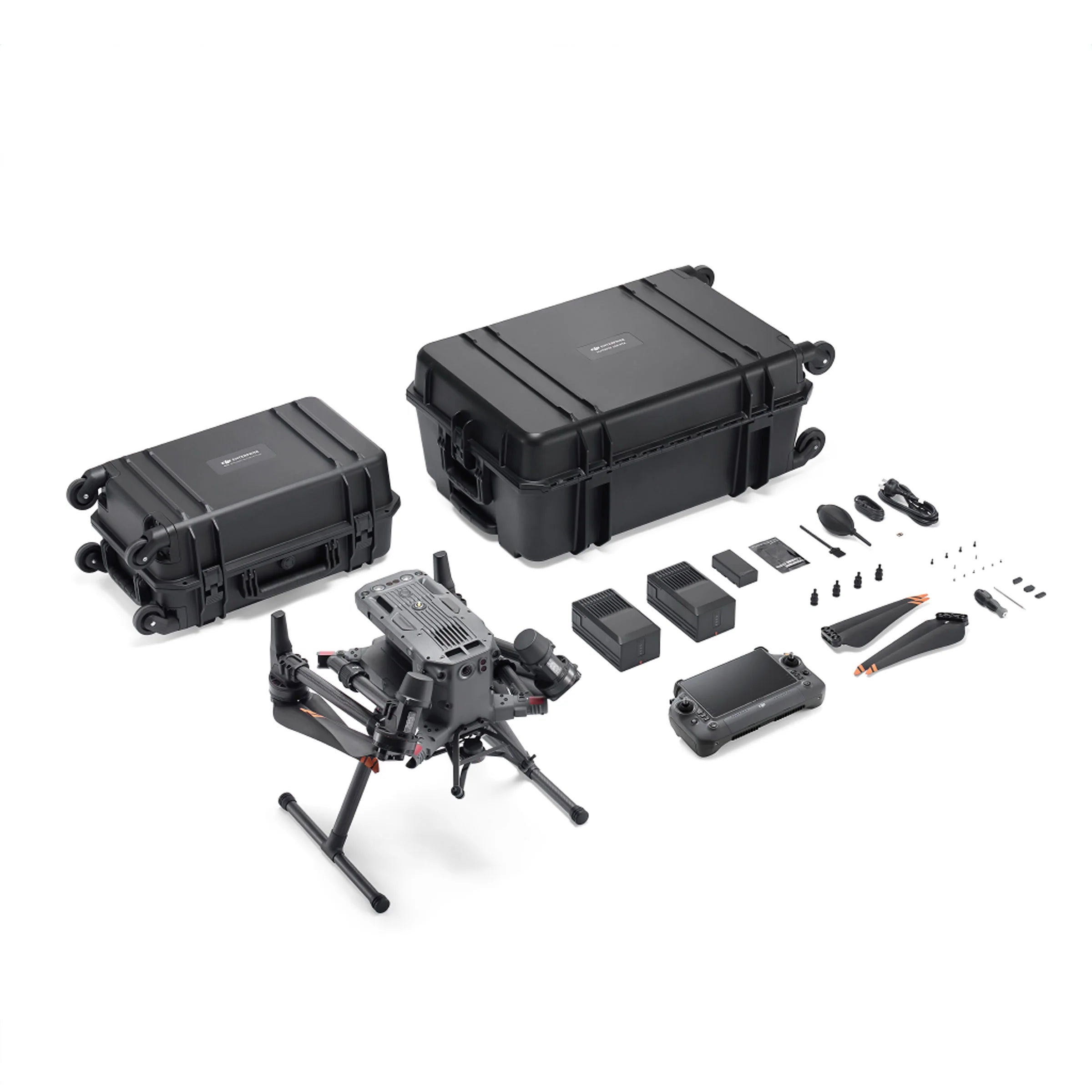
If you manage a large industrial park, a sprawling corporate campus, or a skyscraper, you need an aerial platform capable of operating 24/7.
Advantages of the DJI M350 RTK: An industrial-grade device with an IP55 protection rating. Equipped with the latest multi-sensor payloads (such as the H30T or H20T), it offers unparalleled zoom capabilities, a high-precision laser rangefinder, and advanced night vision.
Disadvantages: It requires a larger investment, and for optimal safety, it needs two operators and more intensive pilot training.
5. Autel EVO II Pro RTK V3 – High-Definition Mapping Aerial Platform

If you manage a small industrial park or construction site, you need a portable, affordable high-definition visual RTK drone.
Drone Advantages: 6K 20MP high-definition camera sensor, centimeter-level mapping accuracy, supports automatic drone flight path planning, 360° obstacle avoidance, and a 36-minute long flight time.
Building a Drone Solution for Exterior Wall Inspection
Purchasing a drone platform is only half the battle. To achieve a true return on investment, the drone's images must be processed using video surveying or photogrammetry software such as Autel Mapper, Pix4D, or SkyeBrowse.
These platforms automatically stitch together photos or video logs from the drone into an interactive, georeferenced 3D digital twin model of your building. You can virtually rotate the building on your computer, zoom in to view precise coordinates, mark defects, measure concrete spalling, and export detailed PDF files directly to your structural engineering or maintenance team.
Conclusion
The introduction of drones for inspecting the curtain walls of high-rise buildings is a significant step in the digital transformation of the property management industry. Using drones not only reduces costs and increases efficiency and improves security, but also significantly enhances service professionalism, creating a differentiated advantage in the highly competitive property management market.
Start leveraging drone services for high-rise building management by purchasing an Autel EVO Max 4T V2 drone.