


Energy Facility Security: An Integrated Air-Ground Defense Solution
Energy is the lifeblood of the national economy. As electricity, oil and gas, wind power, photovoltaic, and energy storage facilities continue to develop towards larger scale, longer range, and greater intelligence, the security of energy infrastructure is facing new challenges.
In the past, the security of energy facilities mainly relied on manual inspections, video surveillance, access control systems, and traditional security equipment. With the rapid development of the low-altitude economy, drones have become invaluable tools for energy operations and maintenance, but they also bring new low-altitude security threats.
How to safeguard the low-altitude airspace security of energy facilities? Autel Robotics addresses this new challenge by employing an integrated air-to-ground defense system combining drone inspection and counter-drone detection to comprehensively mitigate intrusion risks.

What is Autel Robotics' Energy Facility Security Solution?
The Autel Robotics Energy Facility Security Solution integrates multi-rotor drones, the Nest system, counter-drone equipment, and the AICS system, designed to protect complex and dispersed energy facilities. This solution provides integrated air-to-ground defense, all-weather autonomous operation, and AI-driven risk detection and automatic alarm functions, ensuring comprehensive protection against intrusion risks.
Why should energy facilities focus on low-altitude security?
Energy infrastructure typically covers large areas, is geographically dispersed, with some facilities located far from cities. It involves a large number of devices and often operates unmanned or minimally staffed environments, requiring continuous operation.
In national infrastructure projects, a single power transmission line may span hundreds of kilometers; a large photovoltaic power station may cover a vast area; and wind farms are typically located in mountainous, desert, or coastal regions.
Traditional manual inspections struggle to achieve 24/7, comprehensive coverage and timely responses to anomalies.
Drone inspections improve efficiency, but how to identify unauthorized drones entering these areas? This necessitates the deployment of counter-drone detection measures.
Air-Ground Integrated Defense: Drone Inspections
Traditional manual inspections are inefficient, risky, and lack comprehensive coverage. Drones, with their flexibility, cost-effectiveness, and abundant data, are fundamentally changing energy operation and maintenance models.
Power Line and Substation Inspection
The multi-sensor EVO Max series drones, equipped with high-definition visible light, infrared thermal imaging, starlight cameras, and laser rangefinders, can quickly detect defects such as broken conductor strands, damaged insulators, tree obstructions, and equipment overheating.
Even in emergency circuit repairs at night, drones can provide immediate on-site dynamic perception, increasing inspection efficiency several times or even tenfold.

Oil & Gas Pipeline and Station Monitoring
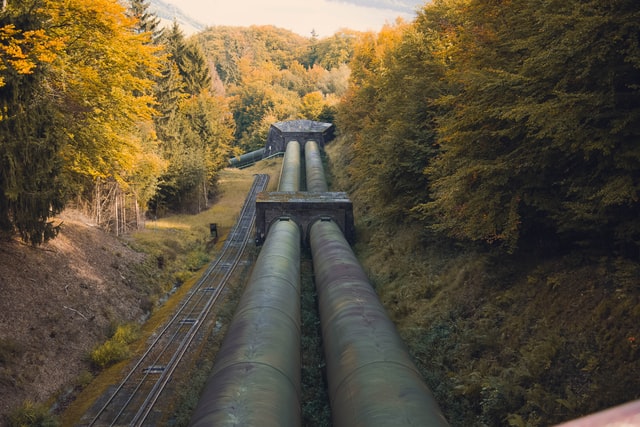
Long-endurance drones and their associated drone nests play a crucial role in the inspection of long-distance oil and gas pipelines. Routine drone inspections can detect potential hazards such as third-party construction damage, leaks, and corrosion, focusing on high-risk areas.
New Energy Station Operation and Maintenance
In solar/wind power generation, drones' long-range zoom and thermal imaging capabilities can be used to detect hot spots on photovoltaic modules and inspect wind turbine blades for cracks, achieving large-scale, routine coverage.

Emergency and Security Assistance
In case of anomalies, drones can quickly conduct reconnaissance. At night, the Max 4N drone can clearly perceive details in the darkness, track suspicious targets, and promptly relay the situation to the commander, enabling rapid activation of emergency plans.

The Autel Dragonfish series and EVO Max series, combined with automated take-off and landing nests, AI image recognition, and a cloud platform, have been upgraded to become routine intelligent sensing nodes for energy facilities, significantly improving safety operation levels and response speed.
Read More:View Autel Energy and Utility Drones
Air-Ground Integrated Defense: Counter-Drone Detection
The importance of energy infrastructure is self-evident. Counter-drone detection requires knowing whether a drone has been detected, its location, its direction of flight, whether it has entered a pre-defined warning zone, and whether it is part of an authorized flight mission.
In environments with strong electromagnetic fields and complex terrain, traditional ground-based security measures struggle to effectively cover low-altitude blind spots. Early detection, identification, and tracking of illegal drones, and distinguishing between "legitimate friendly flights" and "external threats," is the first and most crucial step in protecting energy facilities.
The Autel Alpha Trace UAV Pilot Positioning Solution is designed to solve the problem of detecting drone pilots without broadcast protocols (drone ID and remote ID). The STA100 tracer radio detection device supports a detection range of 3 kilometers and can simultaneously detect up to 6 target sources.

The EVO Max series with a GNSS anti-jamming module for multi-directional GNSS anti-jamming, GNSS anti-spoofing, and real-time signal monitoring, preventing signal interference and spoofing in complex electromagnetic environments during normal drone inspections.

Our Solutions
1. Dragonfish Standard + Dragonfish Nest + Autel Integrated Command System + Dragonfish Launcher

The Dragonfish Standard, combined with the Dragonfish Nest for charging and takeoff/landing, allows for approximately 106 minutes of continuous flight per charge, a maximum speed of 108 km/h, and a transmission distance of 45 km.
The Dragonfish Launcher easily extends the firing range, while AICS provides remote command and control, ensuring data security.
2. EVO Max 4T V2 + EVO Nest + Autel Integrated Command System

TheEVO Max 4T V2 features 10x optical zoom, 160x hybrid zoom, 720° omnidirectional obstacle avoidance, triple anti-interference capabilities, and an A-Mesh networking structure supporting multi-drone swarm operations, with a maximum flight time of 42 minutes.
The EVO Max 4T V2, paired with the EVO Nest, achieves stable connectivity, takeoff/landing, and charging within a 7 km operating range, while AICS provides real-time situational awareness and data security.
In summary
Energy security is of paramount importance. Autel Robotics integrates drone inspection and counter-drone detection into a unified air-to-ground defense solution, providing all-weather, three-dimensional protection for the energy security of power systems, oil and gas facilities, and new energy power plants.