


Using Autel Drones for Search and Rescue: Tools, Tips & Best Models
In the past, rescue and search operations were often conducted using only human labor, which was inefficient and highly risky. This was particularly true in complex geographical environments such as highlands, forests, and oceans, where such conditions significantly increased the difficulty of search-and-rescue efforts.
However, with the advancement of drone technology, Autel drones are being increasingly deployed in search-and-rescue missions, offering new possibilities for improving the efficiency and safety of these operations.
So, how are Autel drones used in search and rescue missions? What role do they play? What are their advantages? Which Autel drones are suitable for search and rescue missions?
Why Use Drones for Search and Rescue Operations
Search and Rescue (SAR) falls under the category of public safety operations and primarily involves various activities aimed at locating missing persons. In most countries, SAR operations are typically carried out by government agencies or professional rescue teams to ensure efficient and safe search and rescue efforts. So why use drones for search and rescue operations?
Faster Area Coverage and Real-Time Visibility
During search and rescue operations, missing persons are often in life-threatening situations, and time is of the essence; therefore, they must be located as quickly as possible. Drones can rapidly cover large areas and provide real-time visibility, thereby significantly improving search and rescue efficiency and saving valuable time.

Fast area coverage with Autel drones
Thermal Imaging for Night and Low Visibility
In many search and rescue operations, especially those conducted at night or in low visibility conditions, thermal imaging technology is crucial. Drones equipped with thermal cameras can detect heat signatures from missing persons, making it easier to locate them even in complete darkness or through dense foliage.
Enhanced Communication and Coordination
During rescue operations, drones can be equipped with speakers to repeatedly broadcast messages, alerting missing persons to the presence of rescue teams and enabling them to receive assistance. At the same time, drones can serve as communication relays, improving communication between rescue teams and the command center.
Access to Dangerous or Inaccessible Areas
Drones can be used to access dangerous or inaccessible areas, such as steep cliffs, collapsed buildings, or disaster zones, where human rescuers may face significant risks. This allows for safer and more effective search and rescue operations.
Key Features for Drone-Based Search and Rescue
When selecting drones for search and rescue operations, there are several key features to consider:
1. Thermal Imaging Inspection
Thermal imaging technology plays a crucial role in search and rescue operations. Not only does it help rescue personnel quickly locate missing persons, but it also provides effective search support in adverse weather conditions and low visibility.
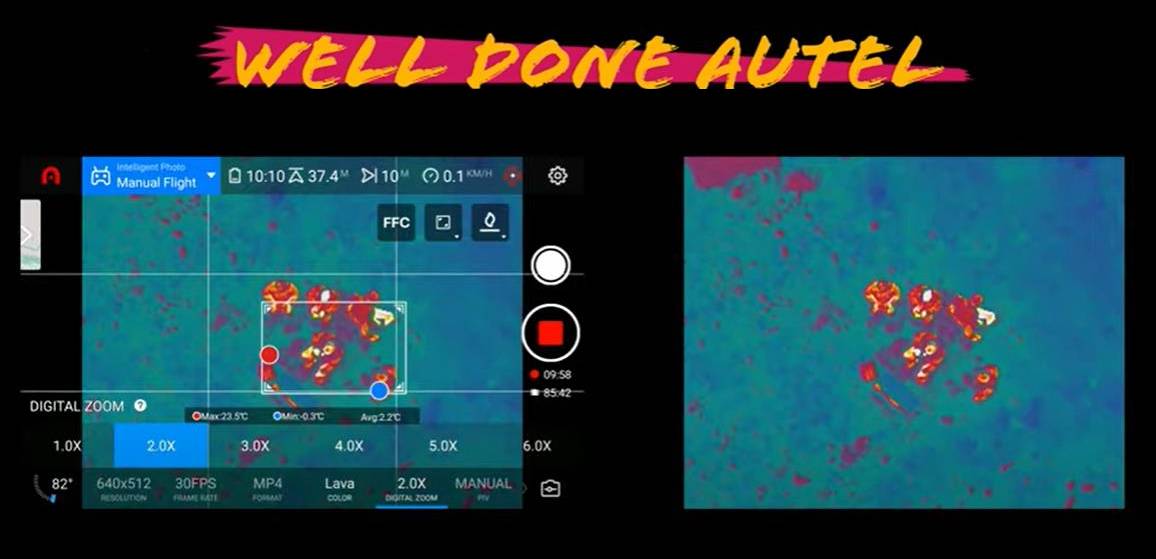
Thermal imaging inspection with Autel drones
The Autel thermal drone is equipped with a 640×512-pixel thermal imaging camera, capable of delivering clear thermal images in a variety of environments. It also features multiple temperature measurement modes and offers the following key features:
- Central, Spot, And Regional Temperature Measurement
- Temperature Alarm And Image Enhancement
- 10 Thermal Color Palettes
- Powerful Infrared Thermal Analysis Tool
- Picture-in-Picture Display Mode
2. Long Flight Time and Extended Range
In search and rescue operations, drones need to cover large areas and operate for extended periods. Therefore, long flight time and extended range are essential features to ensure that drones can effectively support search and rescue efforts.
Autel SAR drones, such as the Autel EVO Max 4T V2, can fly for up to 42 minutes and have a maximum video transmission range of 12.4 miles. These capabilities help maximize the duration and scope of search and rescue operations, significantly increasing the success rate of such missions.
3. Accurate Object Identification and Tracking
Some drones today are equipped with AI recognition technology that can even be customized to identify specific targets. This technology can automatically identify and lock onto various targets, such as heat sources, moving people, or vehicles.
In search and rescue missions, AI recognition and tracking technology has transformed drones from “passive observation tools” into “active search and rescue systems,” significantly improving search efficiency, target localization accuracy, and overall rescue success rates.
Autel drones are equipped with advanced AI recognition and tracking capabilities, allowing them to quickly identify and track targets in complex environments.

AI recognition and tracking capabilities in search and rescue operations
4. 24/7 All-Domain Operations Autonomous Flight
Some advanced drones are capable of precise navigation, autonomous obstacle avoidance, and real-time path planning under a variety of complex conditions, including day and night, low-light environments, and situations without GNSS signals. With the aid of multispectral fusion sensing systems, they can clearly identify and track targets and collect relevant data even in near-total darkness.
The Autel EVO III series of drones, set to launch in 2026, will be capable of this functionality. This capability not only ensures that search and rescue missions can proceed as normal even under extremely harsh conditions, but also improves the efficiency and success rate of such operations.
Essential SAR Drones Tools & Accessories
In addition to the drones themselves, there are several essential tools and accessories that can enhance the effectiveness of search and rescue operations:
- Radiometric Thermal Sensors: Essential for spotting body heat in darkness or dense brush. Look for 640 x 512 resolution to ensure you can distinguish a human from a rock at a safe altitude.
- Laser Rangefinders (LRF): Standard on the EVO Max series, this allows you to instantly get the GPS coordinates of a victim from a distance, making it easier to guide ground teams.
- Loudspeakers and Spotlights: A vital tool for providing instructions or reassurance to a lost individual. It bridges the gap between locating a victim and the physical rescue. High-intensity spotlights help illuminate treacherous terrain for ground crews and provide visual confirmation during night operations.
- Autel Smart Controller V3: With its 2,000-nit high-brightness screen, it ensures you won't lose sight of the thermal feed even in harsh, direct sunlight.
- RTK Modules: Real-Time Kinematic (RTK) technology provides centimeter-level positioning. This is critical for creating precise 3D maps of disaster zones or ensuring 100% area coverage during automated grid searches.

Applications of Spotlights on Autel Drones
Best Autel Drones for Search and Rescue
When it comes to selecting the best Autel drones for search and rescue operations, several models stand out due to their advanced features and capabilities:
Autel Robotics EVO Max 4T V2
The Autel EVO Max 4T V2 is a top-tier search and rescue drone designed for extended flight times and robust performance in challenging environments.
- Thermal imaging + visible light + laser ranging in one
- Supports flight in GPS-denied environments (particularly advantageous in complex environments)
- High resistance to interference (ideal for disaster zones and urban environments)
- 42-minute flight time + ultra-long-range video transmission (ideal for large-scale search operations)
Ideal for: Fire departments, public safety agencies, and professional search and rescue teams

Autel EVO Max 4T V2 Overview
Autel Robotics EVO II Dual 640T V3
The Autel EVO II Dual 640T V3 is another excellent option for search and rescue operations, offering dual thermal cameras and enhanced performance. It is equipped with a 640 x 512 high-resolution thermal imaging camera featuring a 13mm focal length lens and 16x digital zoom, it is easier than ever to observe distant targets.
The system uses a new image processing algorithm, making thermal details clearer and more discernible than other options with similar resolution and hardware.
- 640×512 thermal imaging resolution, suitable for most SAR requirements
- Lower cost, making it an entry-level thermal imaging solution
- Reliable performance, ideal for routine missions
Best for: Teams with limited budgets that require thermal imaging
Autel Robotics EVO Lite 640T
The Autel EVO Lite 640T is a more affordable option for search and rescue operations, offering essential thermal imaging capabilities without the premium price tag.
- Equipped with a dual-gimbal system featuring a visible-light camera and a thermal imaging camera
- easy operation, user-friendly interaction
- Compact and portable design
- See More with Split-Screen Zoom
Best for: Mobile search and rescue / Volunteer teams / Rapid response missions

Autel EVO Lite 640T Overview
Tips for Effective Search and Rescue Missions with Autel Drones
To maximize the effectiveness of Autel drones in search and rescue missions, consider the following tips:
- Plan Your Search Area: Divide the area into grids and prioritize high-probability zones (last known location, trails). Use tools like Autel Explorer to ensure systematic coverage.
- Use Thermal Imaging at the Right Time: Thermal works best in cooler conditions (early morning or night). Avoid midday heat, which can reduce contrast and make detection harder.
- Leverage AI Detection and Tracking: AI features can help identify and track targets in real time, reducing workload and improving efficiency—but always verify results manually.
- Maintain Signal Stability: Keep a strong connection by avoiding obstacles and maintaining line of sight. Stable transmission is critical for real-time decision-making.
- Coordinate with Ground Teams: Share live footage and GPS locations to guide responders quickly. Drone data is most valuable when integrated with ground operations.
- Manage Battery and Flight Time: Plan for multiple flights, carry spare batteries, and rotate drones if needed to ensure continuous coverage.
Conclusion
Drones are playing an increasingly important role in search and rescue missions, not only improving search efficiency but also increasing the success rate, thereby making search and rescue operations more efficient and safer. No matter how harsh the rescue environment, drones can penetrate deep into the search area, demonstrating advantages over purely manpower-based search and rescue efforts.
Autel drones are transforming search and rescue operations by providing more efficient and safer solutions. Whether in wildlife rescue missions or disaster response, Autel drones have demonstrated tremendous potential and value.